Guide · · 4 min read
The Bortle Scale Explained
Nine classes that describe how dark a sky is, and why the numbers on our map are estimates.
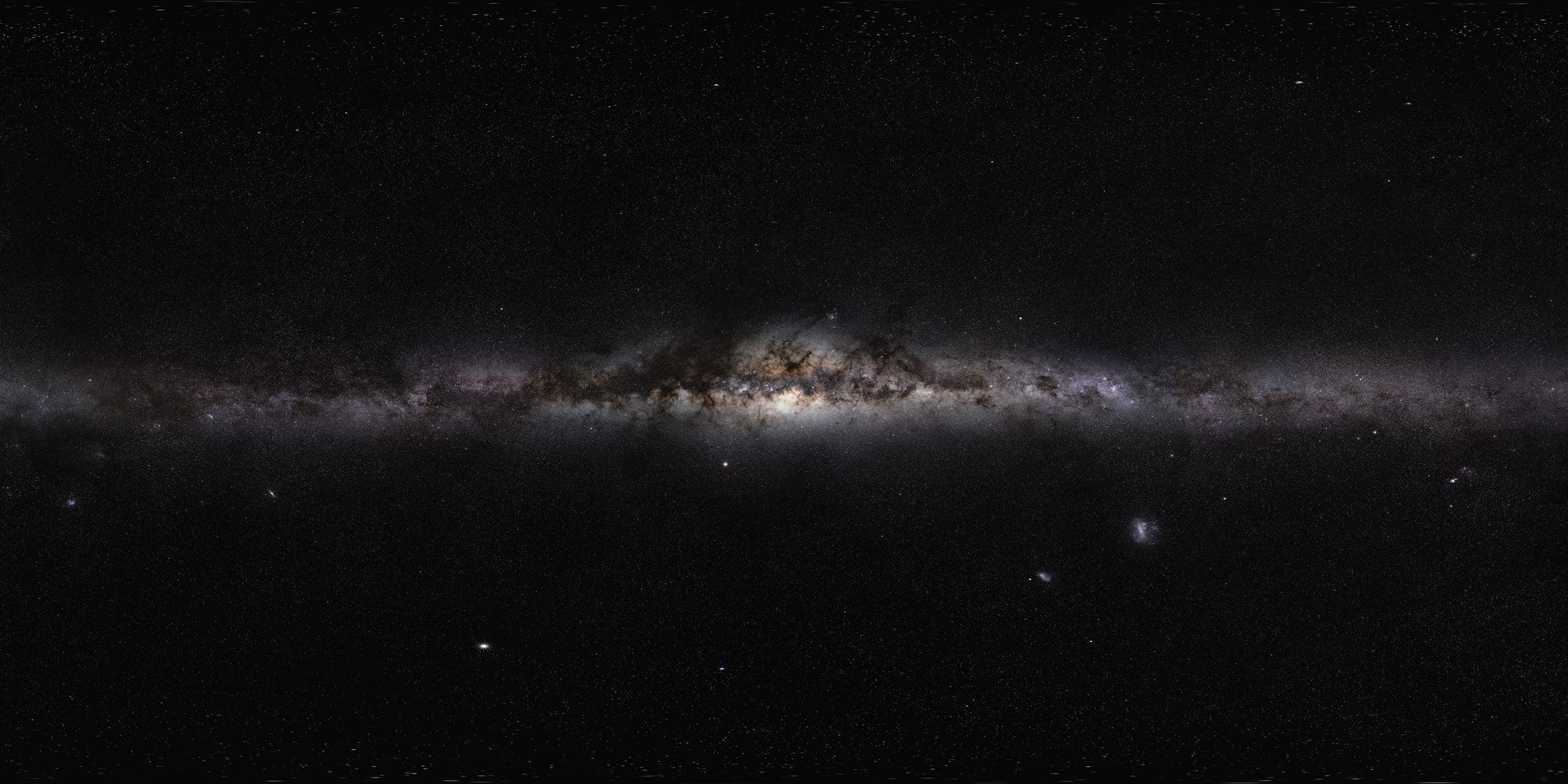
ESO/S. Brunier · CC BY 4.0
The Bortle scale was proposed by the American amateur astronomer John E. Bortle in Sky & Telescope in 2001. It divides the night sky into nine classes, from class 1, a truly dark site, to class 9, the centre of a large city. Its strength is that it needs no instrument: each class is described by what the naked eye can see.
Reading the classes
At classes 1 and 2 the Milky Way is bright enough to cast a faint shadow, the zodiacal light is obvious after dusk, and clouds show only as black patches blotting out stars. Class 3 is rural sky: the Milky Way still shows clear structure, but a few faint light domes sit on the horizon. Class 4 marks the transition between countryside and suburb, where the Milky Way remains visible but loses detail near the horizon. From class 5 upwards it fades and then disappears, and at classes 8 and 9 only the brightest stars and planets remain.
The SQM number
If the Bortle scale is a description, SQM is a measurement. It records the brightness of the sky background at the zenith in magnitudes per square arcsecond. Larger numbers mean darker skies. The darkest natural sky on Earth is around 22.0; a good rural site sits around 21.5 to 21.8; suburbs are often near 19 to 20; a large city centre can fall below 18. Because magnitudes are logarithmic, a difference of one unit corresponds to a sky background roughly 2.5 times brighter.
Why our map says estimate
The Bortle and SQM values on the Sao Viet map are estimates, based on satellite data on artificial light and on field knowledge, not on readings taken at each site. The real sky also depends on humidity, dust, the Moon's altitude and the direction you face. A site marked class 3 can feel like class 2 on a dry, breezy night, and worse than class 4 when mist reflects the lights of a nearby town.
Estimating it yourself
The simplest method is to count stars inside a familiar constellation, or to check whether you can trace the structure of the Milky Way around Sagittarius. Give your eyes at least twenty minutes to adapt and avoid any phone screen without a red-light mode. Note your impression after every trip: over many nights, that record becomes the most reliable measure of a sky you know.
Comments
02- ĐĐức Minh#01
Bài viết rõ ràng. Thích phần giải thích vì sao Bortle chỉ là ước tính.
- NNgọc Lan#02
Có thể thêm bảng so sánh SQM đo thực tế ở vài điểm được không?